Executive Summary: Progress Software has recently issued an urgent patch for a critical vulnerability affecting its Kemp LoadMaster application delivery controllers. Tracked as CVE-2026-8037, this security flaw carries a CVSS score of 9.6, indicating its highly severe nature. Unauthenticated remote attackers are actively exploiting this pre-authentication Operating System (OS) command injection vulnerability in the wild, allowing them to execute arbitrary commands on target appliances with root privileges. Since load balancers are key gateway components inside enterprise networks, immediate patching is strongly recommended to avert full system compromise. If left unpatched, an adversary can leverage this vulnerability to gain a massive foothold within enterprise network perimeters.
Deep-Dive Technical Analysis of CVE-2026-8037
CVE-2026-8037 stems from improper validation of input supplied to the API of Progress Kemp LoadMaster. Specifically, the flaw exists within the /accessv2 endpoint of the LoadMaster management interface, which fails to sanitize user-supplied input before executing shell commands. This input validation failure opens the door for sophisticated threat actors to compromise the core application delivery controller.
An unauthenticated attacker can construct a crafted HTTP request targeting the exposed /accessv2 API endpoint. By embedding OS-specific command separators (such as semicolons, ampersands, or backticks) within the input payload, the attacker causes the system's command processor to execute arbitrary commands on the underlying operating system. Because the administrative services on LoadMaster appliances run with elevated privileges, the injected commands are executed with administrative or root-level permissions. We have seen similar behavioral traits in recent widespread attacks against network edge devices.
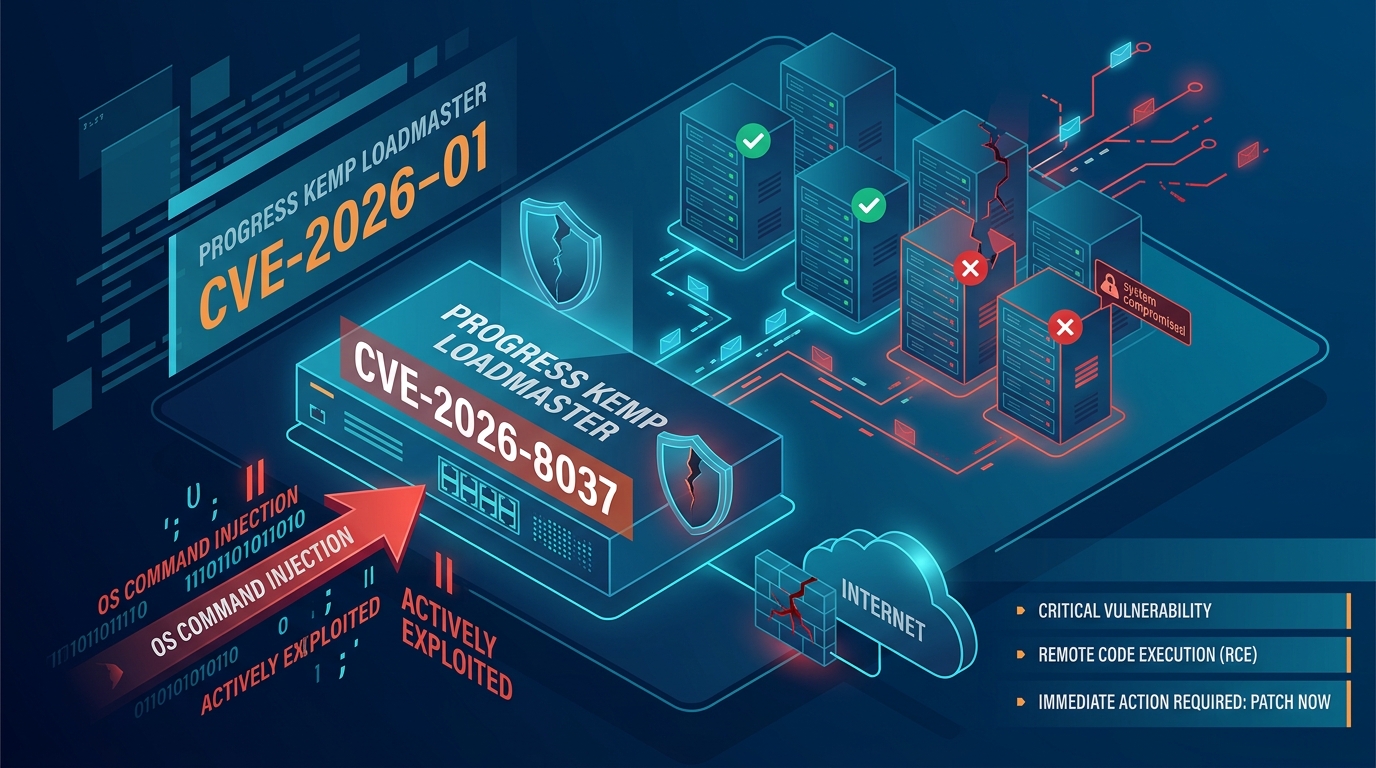
A public proof-of-concept (PoC) exploit was published on June 29, 2026, which triggered a massive wave of active scanning and real-world exploitation attempts targeting enterprise networks with exposed API endpoints. This vulnerability bears high similarity to CVE-2024-1212, another critical OS command injection flaw in Kemp LoadMaster that faced extensive real-world exploitation in late 2024. The rapid mobilization of cybercriminal organizations to weaponize these proofs-of-concept emphasizes the severe threat landscape.
Industry Impact and Strategic Recommendations
Load balancers occupy a highly sensitive segment of enterprise networks, acting as the gateway for public-facing web applications and internal server pools. Compromise of a Kemp LoadMaster appliance allows threat actors to intercept decrypted SSL/TLS traffic, execute lateral movement across internal subnet zones, perform data exfiltration, or install persistent backdoors. This lateral movement capability transforms a single edge device vulnerability into a widespread, systemic enterprise breach.
We strongly advise network administrators, Chief Information Security Officers (CISOs), and security operations teams to implement the following immediate mitigation and remediation measures:
- Apply Official Patches Immediately: Ensure all Kemp LoadMaster deployments are updated to the latest firmware version released by Progress Software. Refer to the official vendor portal for specific version guidelines and release notes.
- Restrict Management API Access: Restrict external access to the LoadMaster management interface and associated API. The management interface should never be exposed to the public internet; it must be shielded behind an enterprise Virtual Private Network (VPN) or restricted to specific, trusted administrative IP addresses using strict Access Control Lists (ACLs).
- Audit Log Inspection: Inspect appliance access logs, specifically checking for unauthenticated requests directed at
/accessv2or unusual payload parameters. Monitor network traffic for outbound connections initiated directly from the load balancer to unknown external IP addresses or command and control (C2) servers. - Implement Web Application Firewalls (WAF): Deploy robust Web Application Firewall rules designed to actively detect and block common OS command injection signatures in incoming API requests.
Frequently Asked Questions (FAQ)
To provide additional clarity on the CVE-2026-8037 exploit and its far-reaching consequences, we have compiled the most frequently asked questions from the cybersecurity community.
What is CVE-2026-8037?
CVE-2026-8037 is a critical OS command injection vulnerability in Progress Kemp LoadMaster with a CVSS score of 9.6. It allows unauthenticated remote attackers to execute arbitrary commands with root privileges by sending maliciously crafted payloads to the appliance's management interface.
How do attackers exploit the Kemp LoadMaster vulnerability?
Attackers exploit this flaw by sending crafted HTTP requests to the exposed /accessv2 API endpoint, embedding OS-specific command separators that the system fails to properly sanitize. This results in the direct, unauthenticated execution of arbitrary commands at the root level.
What are the recommended mitigation strategies for CVE-2026-8037?
Administrators must immediately apply the official firmware patch released by Progress Software. Furthermore, restricting access to the management interface via VPN or strict Access Control Lists (ACLs) is an absolutely vital step to prevent unauthorized external exploitation attempts.
References
- Cyber Security Dive
- Cyber Recaps