Physical penetration testing and red-team operations require specialized, field-tested tactical hardware. Discover the complete buyer's and operator's guide to the legendary Hak5 tactical ecosystem—spanning wireless domination, keystroke injection, covert network implants, and modular field kits.
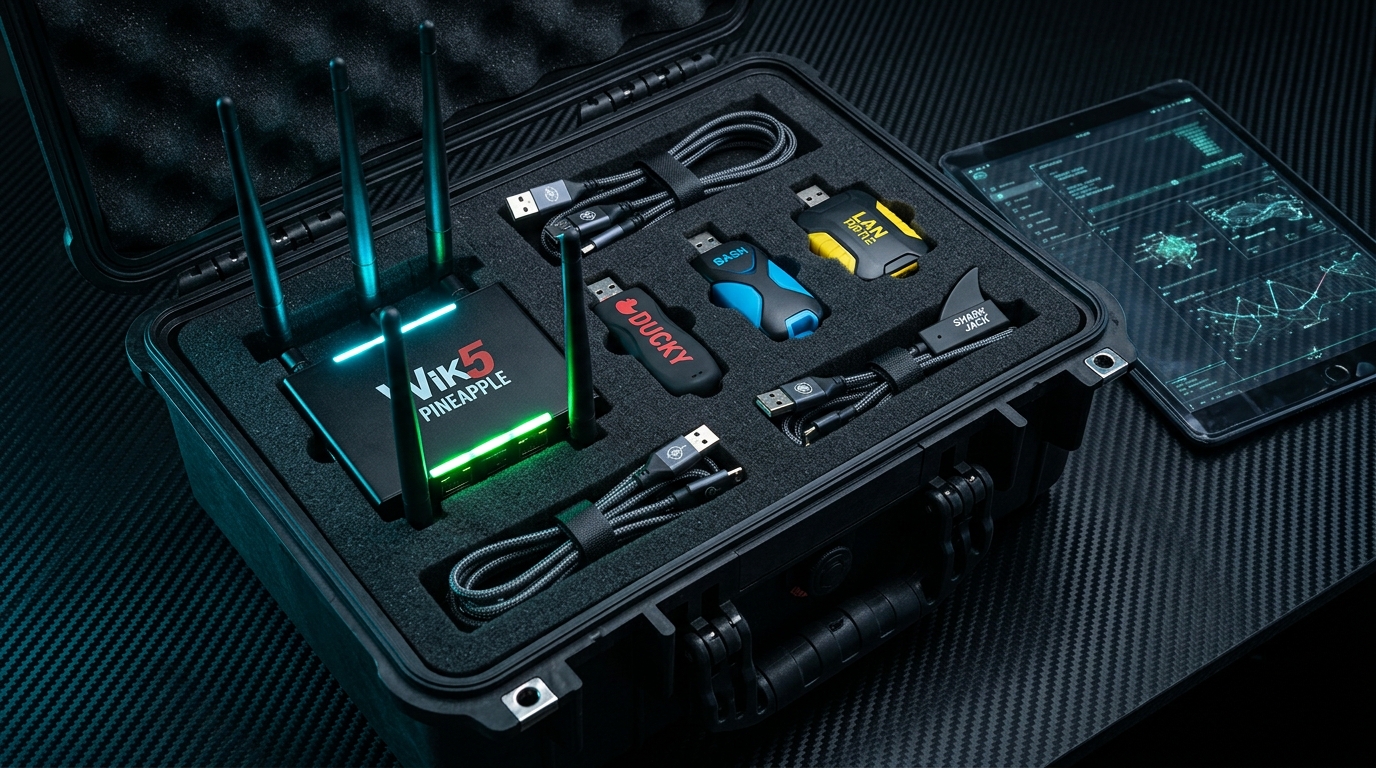
The Red Team Arsenal: Hak5 Hardware Overview
Since 2005, Hak5 has engineered the gold standard in ethical hacking, physical penetration testing, and red team hardware tools. Built on open Linux foundations and supercharged with intuitive web interfaces, cloud management via Cloud C2, and community-driven payload repositories, Hak5 gear allows security auditors to simulate sophisticated real-world adversaries during authorized security assessments.
⚡ Official Hak5 Hardware Categories
- Wireless Auditing & Recon: WiFi Pineapple Mark VII, WiFi Pineapple Enterprise
- Keystroke Injection (HID): USB Rubber Ducky, Bash Bunny Mark II
- Covert Network Implants & Taps: LAN Turtle, Packet Squirrel, Shark Jack
- Physical Surveillance & Keyloggers: Key Croc, Screen Crab, Signal Owl
- Tactical Bundles: Hak5 Elite Field Kit, Essentials Kit
Tactical Product Comparison Matrix
| Hardware Tool | Primary Attack Vector | Target Architecture | Form Factor | Action |
|---|---|---|---|---|
| WiFi Pineapple Mark VII | Rogue AP, PineAP, 802.11 Auditing | Wi-Fi (2.4GHz / 5GHz) | Dual/Triple Antenna Box | View on Hak5 → |
| USB Rubber Ducky | Keystroke Injection (DuckyScript 3.0) | Cross-Platform USB HID | Flash Drive Enclosure | View on Hak5 → |
| Bash Bunny Mark II | Multi-Vector (HID + Ethernet + Mass Storage) | Debian Linux / Cross-Platform | Multi-Switch USB Stick | View on Hak5 → |
| LAN Turtle | In-Line Network Implant, Reverse SSH, MitM | Ethernet / USB Host | USB-to-Ethernet Adapter | View on Hak5 → |
| Shark Jack | Automated Nmap Recon & Network Triage | RJ-45 Ethernet Jack | Pocket Dongle / LiPo Battery | View on Hak5 → |
| Key Croc | Hardware Keylogger, Cloud Exfiltration, Pattern Alerts | USB Keyboard In-Line | USB In-Line Key Dongle | View on Hak5 → |
| Hak5 Elite Field Kit | Complete Red Team Hardware Fleet | All Vectors (Wi-Fi, USB, LAN, RF) | Rugged Custom Pelican Case | View Field Kit → |
Blue Team Defenses: How to Mitigate Physical & Wireless Hardware Attacks
Understanding offensive hardware is essential for establishing defense-in-depth security architectures. Blue teams and enterprise security engineers should deploy the following mitigation controls:
- Enforce USB Device Whitelisting: Deploy Endpoint Detection & Response (EDR) policies that block unauthorized USB VID/PID classes, preventing unknown HID devices from registering.
- Implement 802.1X Network Access Control (NAC): Require digital certificates or EAP-TLS authentication for all physical Ethernet switch ports, mitigating unmanaged LAN Turtle and Shark Jack implants.
- Deploy WIDS/WIPS Wireless Monitoring: Configure continuous rogue AP detection to flag SSID impersonation and high-frequency deauthentication frames generated by PineAP suites.
- Disable BIOS/UEFI USB Boot: Lock system firmware with administrative passwords and enforce Full Disk Encryption (FDE) using TPM-bound BitLocker or LUKS.
Frequently Asked Questions (FAQ)
What is the most popular Hak5 tool for beginners?
The USB Rubber Ducky and Shark Jack are excellent entry points due to their straightforward payload execution models, extensive community documentation, and intuitive scripting languages.
Can Hak5 devices be controlled remotely?
Yes. Many modern Hak5 tools integrate seamlessly with Hak5 Cloud C2, providing encrypted web dashboards for payload deployment, real-time command shells, and exfiltration monitoring over the internet.