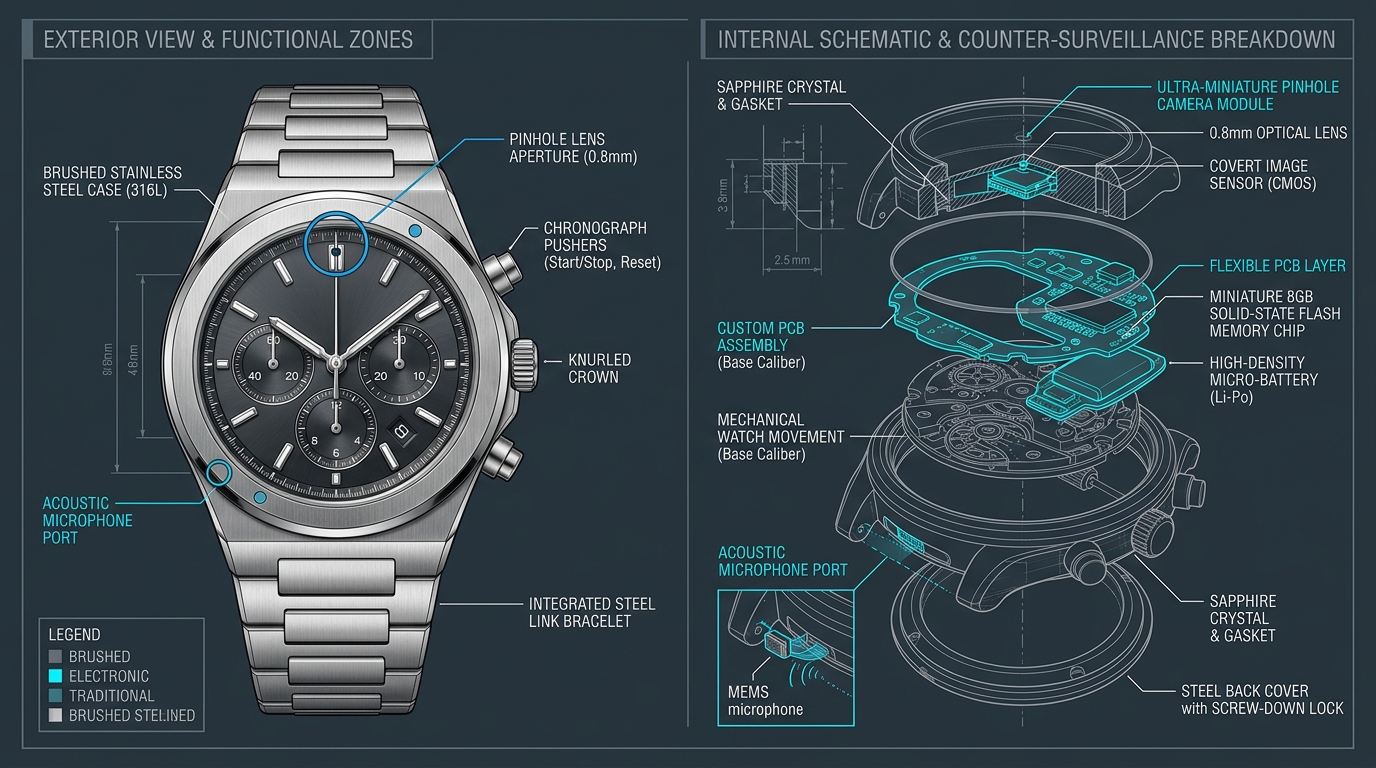
Concealed audio-visual recording wristwatches have evolved from clunky novelty gadgets into convincing stainless-steel men's dress chronographs and dive watches. First highlighted in organized-crime law enforcement bulletins (including Criminal Intelligence Service Ontario advisory CISO 012-09), wearable DVR chronographs pair an analog quartz movement with an independent digital video recorder, acoustic microphone, sub-millimeter pinhole CMOS lens, and 8 GB to 128 GB of onboard NAND flash—creating both a passive room-recording sensor and a disguised data-smuggling container.
Internal Architecture of a Covert DVR Chronograph
Early generation surveillance watches cataloged in law enforcement advisories captured 352 × 288 Common Intermediate Format (CIF) MJPEG/AVI video streams at 15 frames per second onto an integrated 8 GB flash chip. Subsequent commercial iterations retained identical external watchmaking camouflage while upgrading internal board-level sensors to 1920 × 1080 H.264/H.265 video at 30 fps alongside invisible 940 nm infrared (IR) night-vision emitters arranged as decorative dial hour markers.
Crucially, as intelligence bulletins warned search officers, modern surveillance watches do not expose a visible USB Type-A plug on the strap. Whereas first-generation "USB memory watches" could be spotted immediately by pulling a rubber tab out of the wristband buckle, dress chronograph DVRs hide their electrical interface completely behind a threaded, O-ring-sealed secondary crown cap—connecting via a proprietary 4-pole 2.5 mm TRS sub-miniature plug or magnetic pogo-pin dock cable that carries both 5V charging current and USB 2.0 D+/D- differential data lines.
| Hardware Subsystem | Camouflage Location on Watch Case | Visual, Optical & TSCM Inspection Signature |
|---|---|---|
| Micro-Pinhole CMOS Lens (0.8 mm–1.2 mm) | Drilled inside the numeral "6" or "12", centered in a faux tourbillon/chronograph sub-dial, or tucked into a bezel minute marker | 10× jeweler's loupe or pulsed optical retro-reflective lens finder reveals a recessed anti-reflective glass aperture behind the dial face |
| MEMS / Electret Acoustic Port | Concealed inside a hollow chronograph pusher button at the 2 o'clock, 4 o'clock, or 10 o'clock case flank | Asymmetric tactile pusher travel: one pusher actuates the DVR power/record microswitch while a dummy crown houses an acoustic pinhole |
| Hidden USB Data & Charge Jack | Seated beneath a screw-down decorative crown cap on the 9 o'clock or 4 o'clock case wall | Unscrewing the secondary cap exposes a 2.5 mm 4-conductor micro-jack rather than a mechanical time-setting stem |
| Split Power & PCB Stack | SR626SW silver-oxide button cell drives analog hands; separate 3.7V 250–380 mAh LiPo pouch powers the SoC/NAND | Analog hands continue ticking normally even when the DVR battery is completely depleted; case thickness typically measures 14 mm–16.5 mm |
Dual Threat Model: Zero-RF Collection & Covert Data Exfiltration
Technical Surveillance Countermeasures (TSCM) engineers and organized-crime investigators classify wearable DVR watches as a dual-vector security hazard inside sensitive facilities, grand jury rooms, and corporate boardrooms:
- Zero-RF Passive Recording Immunity: Because self-contained DVR watches write audio and video directly to local solid-state flash without activating Wi-Fi, Bluetooth, or cellular transmitters, real-time RF spectrum analyzers and wireless intrusion detection sensors register zero electromagnetic emissions. Resting a forearm casually along a conference table aims a 6-o'clock dial pinhole horizontally across documents and presenter screens.
- Disguised Mass-Storage Smuggling: When connected to its proprietary 2.5 mm-to-USB transfer lead, the watch's controller (commonly an Anyka, Novatek, or Generalplus SoC) mounts as a standard FAT32/exFAT USB Mass Storage volume capable of holding encrypted VeraCrypt containers, source-code archives, or ledger spreadsheets—bypassing custodial searches that confiscate phones and thumb drives while leaving wristwatches on a suspect's arm or in an unscreened property bag.
TSCM Detection & Digital Forensic Acquisition
Physical & Non-Linear Junction Sweeps
- Non-Linear Junction Detection (NLJD): Even when powered completely off, the high-density CMOS image sensor, DVR System-on-Chip, and NAND flash die inside a recording watch generate a pronounced 2nd-harmonic semiconductor return compared to the tiny single-transistor quartz oscillator inside a genuine mechanical or simple analog dress watch.
- SCIF & High-Security Screening Policy: Sensitive Compartmented Information Facilities (SCIFs), executive M&A war rooms, and custodial interview suites should mandate storing all thick-cased multi-crown chronographs and smartwatches inside external Faraday/acoustic vestibule lockers prior to entry.
Forensic Imaging Without Proprietary Cables
When seizing a suspected recording wristwatch during a search warrant, investigators should search desk drawers and travel pouches for unusually wired USB-to-2.5mm TRS cables—many of which swap standard 5V/GND pinouts to fry generic chargers or confuse casual inspection. In the laboratory, verify pin polarity on the 2.5 mm receptacle with a high-impedance multimeter before connecting through a hardware USB write-blocker, carve unallocated FAT32 clusters for deleted RIFF/AVI or MP4/ftyp frames, and compare the embedded RTC clock-drift banner stamped onto video corners against a known UTC reference.
Field Seizure Checklist
Never discount an analog wristwatch as purely mechanical simply because its sweep second hand continues ticking and no external USB plug is visible on the band; always inspect secondary screw-down crowns and dial numerals under magnification.