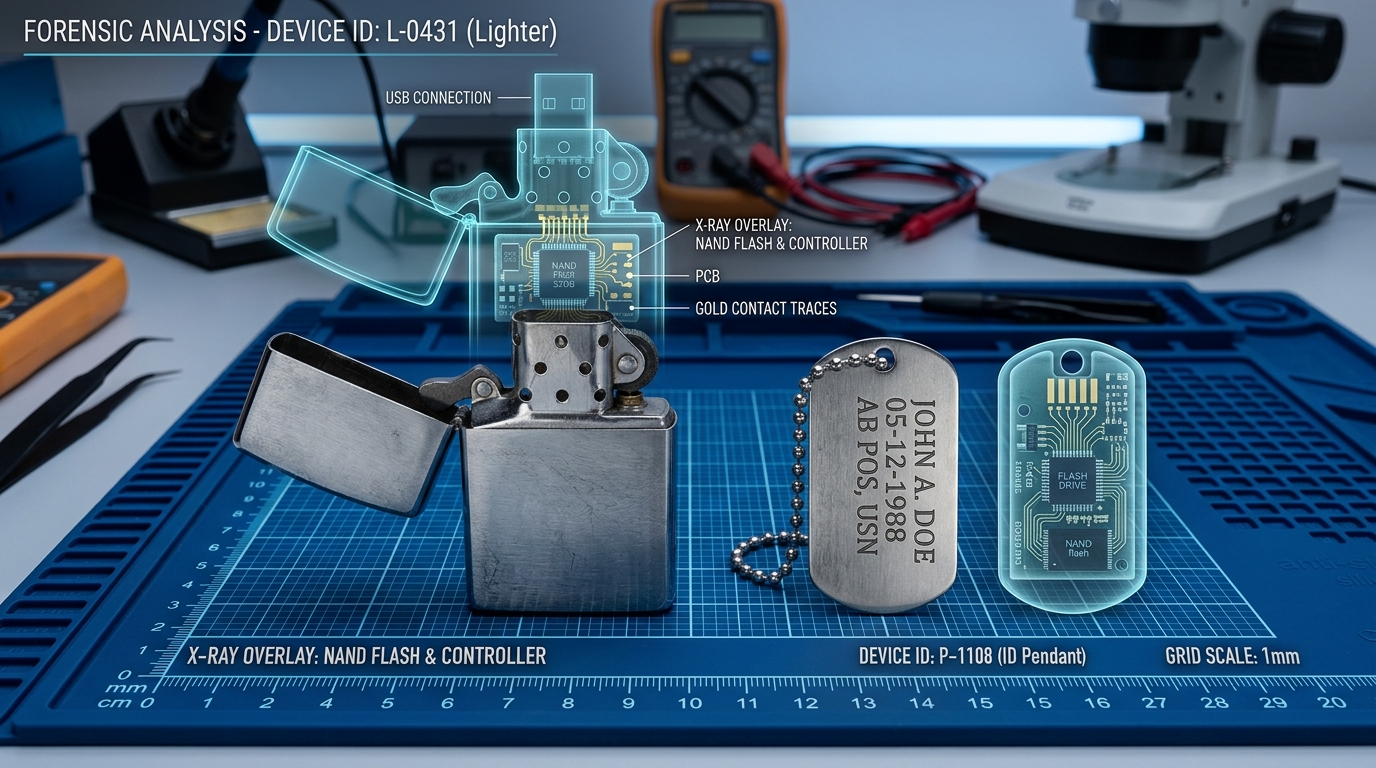
Physical security screening officers and digital forensics examiners increasingly encounter removable solid-state storage and covert utility tools engineered to blend seamlessly into ordinary everyday carry (EDC) items. Because monolithic USB Disk-in-Package (UDP) NAND flash modules measure less than 15 mm by 11 mm by 1.4 mm, high-capacity encrypted storage—as well as non-ferrous edged tools—can be recessed inside butane torch lighters, military identification tags, uniform buttons, hollowed coins, and automotive key fobs.
Case Study 1: Tulsa Airport Torch Lighter USB Flash Concealment
During routine checked-baggage screening at Tulsa International Airport, Transportation Security Administration (TSA) officers flagged an anomalous internal density signature inside a passenger's butane torch lighter. Physical inspection revealed that a removable USB flash key had been recessed into a machined cavity at the base of the lighter housing. Subsequent digital forensic examination of the flash volume uncovered technical documents covering ordnance fabrication, suicide-bombing tactics, chemical poisons, and adult media.
Federal Bureau of Investigation (FBI) agents detained and interviewed the traveler upon arrival in Denver, Colorado, where forensic correlation established that the open-source manuals matched reference libraries compiled by military Explosive Ordnance Disposal (EOD) technicians. Regardless of investigative disposition, the Tulsa seizure demonstrated how effortlessly a modified lighter chassis bypasses superficial visual glances during residential search warrants or corporate perimeter checks.
Why Monolithic Micro-UDP Chips Enable Micro-Enclosures
Unlike legacy thumb drives built on green FR-4 printed circuit boards with discrete TSOP-48 NAND packages and crystal oscillators, modern monolithic UDP wafers encapsulate the NAND die, microcontroller, passive resistors, and four gold-plated USB 2.0/3.0 contact pads inside a single epoxy-molded block smaller than a fingernail. Hollowing out the lower fuel chamber of a brushed-chrome flip lighter or butane torch insert leaves the flint wheel and top cap mechanically convincing while concealing 16 GB to 256 GB of encrypted storage beneath a friction-fit base plate.
| Concealment Form Factor | Internal Payload Architecture | Primary Screening Signature | Forensic & Search Countermeasure |
|---|---|---|---|
| Modified Flip / Torch Lighter | Monolithic USB 2.0/3.0 flash wafer (8 GB–256 GB) epoxied into recessed base cavity | Dual-energy X-ray effective atomic number (Z-eff) contrast between silicon/copper USB contacts and organic butane/cotton | Inspect lighter base seams, false bottoms, and weight balance; image via hardware USB write-blocker |
| Military Dog Tag USB / MicroSD | 2.5 mm laminated tag with swing-out gold USB contact tongue or hidden lateral microSDXC slot | Excess plate thickness (>2.5 mm vs. standard 0.4 mm rolled 304 stainless steel G.I. tag) | Peel back rubber silencer rim during search; inspect perimeter edges under angled illumination |
| Titanium Dog Tag Concealed Blade | 2.0 in × 1.125 in chisel-ground titanium alloy plate inside green or black vinyl anti-rattle silencer | Zero alarm on walk-through ferrous magnetometers; clearly resolved on X-ray & millimeter-wave backscatter | Physically remove rubber silencer borders on all neck-chain tags during custodial and secure-facility searches |
| Machined Hollow Coin & Key Fob | Two-piece CNC-lathed currency coin or car fob hiding a microSDXC card (up to 1 TB) | Micro-seam along reeded edge under 5× loupe and mass/acoustic ring discrepancy when dropped | Explicitly enumerate pocket change, keychains, and EDC containers in digital evidence search warrants |
Case Study 2: Military Dog Tag Concealment — Titanium Blades & Wafer Drives
Alongside lighter modifications, field intelligence bulletins have long tracked the proliferation of dual-purpose military identification tags—most notably the Original Dog Tag Knife designed by a former U.S. Paratrooper for last-ditch survival and evasion. Stamped to exact U.S. military G.I. dog-tag dimensions (2 inches long by 1.125 inches wide) and sold online for $19.95 to $24.95, the plate is fabricated from lightweight non-magnetic titanium alloy with a single-bevel chisel-ground cutting edge.
Two engineering traits make dog-tag disguises uniquely challenging for perimeter guards and patrol officers:
- Magnetometer Transparency: Because titanium exhibits negligible magnetic permeability, a titanium dog-tag blade worn on a non-ferrous bead chain will not trip conventional walk-through or handheld ferrous metal detectors calibrated for carbon steel weapons—requiring backscatter millimeter-wave imaging or manual tactile inspection of the rubber silencer gasket to spot the sharpened bevel.
- Convergence of Physical & Digital Dog-Tag Payloads: Commercial tactical vendors rapidly adapted the exact same rubber-rimmed G.I. silhouette to conceal swing-out USB flash drives, folding micro-scalpels, handcuff-shim utility tools, and programmable 125 kHz / 13.56 MHz RFID access-badge cloners.
Search Warrant Execution & Data-Loss Prevention (DLP) Protocol
In both criminal search warrants (such as child-exploitation, espionage, or financial fraud raids) and classified SCIF / corporate R&D ingress screening, adversaries rely on examiners suffering from "form-factor blindness"—collecting laptops and plastic thumb drives while bagging pocket property into unexamined prisoner-property envelopes.
- Screen Pocket Property Before Returning Personal Effects: Every lighter, metallic dog tag, tactical pen, wristwatch, belt buckle, and key fob recovered from a detainee or desk drawer should undergo tactile seam inspection and portable X-ray or high-intensity visual examination before being logged as non-evidentiary personal property.
- Watch for HID BadUSB Emulation Risks: Never plug a suspect concealed USB wafer directly into an unisolated forensic workstation. Covert EDC drives may house programmable microcontrollers (such as ATmega32U4 or RP2040 implants) configured to emulate a high-speed USB keyboard injecting keystroke payloads; always interpose a dedicated USB mass-storage hardware write-blocker or Linux udev-locked acquisition bridge that drops non-storage HID descriptors.
Operational Reminder for Field Teams
Whenever a rubber-rimmed dog tag feels thicker or stiffer than thin embossed sheet metal—or whenever a torch lighter refuses to spark despite carrying noticeable heft—treat the item as potential concealed digital media or an edged survival tool until physically disassembled.