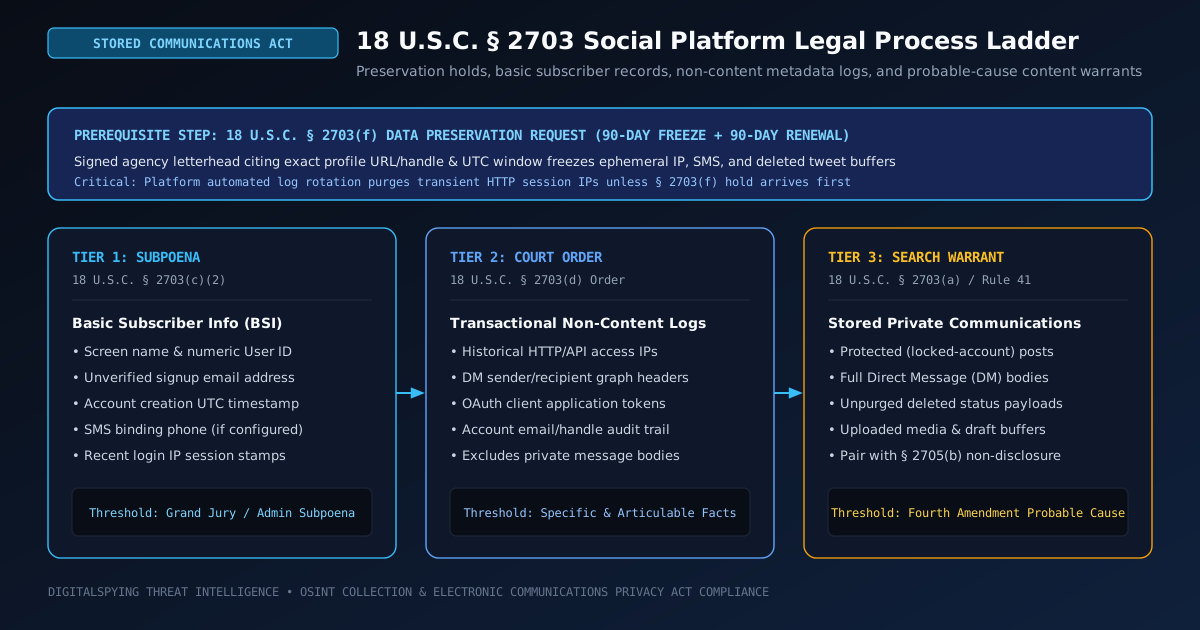
When Twitter published its foundational Guidelines for Law Enforcement, the microblogging service crystallized the operational divide between public real-time Open-Source Intelligence (OSINT)—freely observable across web interfaces and SMS short codes—and non-public electronic communications records governed strictly by the federal Stored Communications Act (SCA), 18 U.S.C. §§ 2701–2712.
Public OSINT Surface vs. Unverified Identity Pitfalls
By architectural design, default microblogging accounts broadcast status updates (originally constrained to 140-character SMS-compatible payloads), follower/following social graphs, profile avatars, biographical strings, and optional user-supplied location tags to the public internet in real time. For cyber-threat analysts and criminal investigators, public timelines require zero legal process to capture—provided examiners preserve evidentiary integrity by hashing raw JSON/HTML responses, recording UTC collection timestamps, and archiving immutable numeric User IDs alongside mutable @handle screen names.
However, as Twitter's compliance documentation explicitly cautioned investigators, account registration does not enforce real-world identity authentication. Threat actors routinely register disposable profiles using throwaway webmail addresses, Tor exit nodes, or commercial VPNs without completing email confirmation. Consequently, user-entered fields (display name, location string, bio URL) must be treated as unverified self-assertions, shifting true attribution onto network-layer telemetry: creation IP addresses, HTTP/OAuth session logs, and SMS mobile carrier bindings.
The Stored Communications Act (18 U.S.C. § 2703) Disclosure Matrix
Under U.S. federal statute and platform Terms of Service, non-public subscriber data, protected (locked) timelines, Direct Messages (DMs), and historical IP session tables cannot be disclosed voluntarily in response to informal inquiries. Investigators must match their legal instrument to the exact statutory tier of records sought:
| Legal Instrument | Statutory Authority | Compellable Platform Records | Evidentiary & Notice Considerations |
|---|---|---|---|
| Preservation Request | 18 U.S.C. § 2703(f) | No immediate data turnover; freezes existing account snapshot, IP logs, and DM buffers for 90 days (renewable once for an additional 90 days) | Must be submitted on signed law enforcement letterhead from an official government email domain citing exact profile URL/ID; user retains normal account access |
| Administrative, Grand Jury, or Trial Subpoena | 18 U.S.C. § 2703(c)(2) | Basic Subscriber Information (BSI): numeric User ID, current/prior screen names, signup email, SMS phone number (if linked), account creation timestamp, and recent login IP stamps | Lowest compulsory threshold; trace returned signup IP and SMS number immediately via downstream ISP/wireless carrier subpoenas |
| Section 2703(d) Court Order | 18 U.S.C. § 2703(d) | Non-Content Transactional Records: extended historical HTTP/API access IP logs, OAuth client source identifiers, DM sender/recipient routing headers (excluding message text), and account audit trails | Requires judicial finding of "specific and articulable facts" showing reasonable grounds that records are relevant and material to an ongoing criminal investigation |
| Probable-Cause Search Warrant | 18 U.S.C. § 2703(a) / Fed. R. Crim. P. 41 | Stored Content: full Direct Message (DM) bodies, protected/private account tweets, uploaded media attachments, and unpurged server-side buffers | Highest Fourth Amendment standard; must be paired with a judicial 18 U.S.C. § 2705(b) non-disclosure order if user notification would jeopardize the investigation |
Critical Role of Immediate § 2703(f) Data Preservation
The single most common procedural failure in social-platform investigations is serving a subpoena weeks after an incident without first transmitting a § 2703(f) preservation request on Day 1. High-volume platforms rotate raw HTTP edge-proxy logs on tight automated retention schedules, and targets frequently scrub incriminating posts or deactivate accounts within hours of an incident.
Mandatory Submission Hygiene for Compliance Intake
- Specify Both Immutable User ID and Full Profile URL: Because a suspect can change their
@screen_namehandle in seconds (releasing the old handle to unrelated users), preservation requests and subpoenas must cite the full profile URL (https://twitter.com/<handle>), the permanent 64-bit numeric User ID, and specific status IDs (Snowflake Tweet IDs encode the exact millisecond UTC creation timestamp in their upper bits). - Authenticate via Official Government Mail Infrastructure: Platform compliance desks (historically
lawenforcement@twitter.comand subsequent dedicated Law Enforcement Request Portals) strictly reject correspondence sent from personal webmail accounts; requests must originate from verified agency domains with complete return contact credentials. - Address User-Notice Policies Proactively: Under platform transparency policies, providers routinely notify target account holders upon receipt of legal process unless legally prohibited by a valid court-issued non-disclosure order under
18 U.S.C. § 2705(b)demonstrating risk of flight, destruction of evidence, witness intimidation, or physical harm. - Correlate SMS & OAuth Client Metadata: Early and modern microblogging logs record the posting client string (e.g., Web, SMS short code
40404, iOS/Android app, or third-party scheduling API) alongside per-post IP addresses—enabling analysts to separate automated bot scheduling from hands-on-keyboard mobile cellular sessions.
Emergency Disclosure Exception (18 U.S.C. § 2702(b)(8))
In imminent life-or-death emergencies involving kidnapping, active violence, or credible self-harm threats where delay to obtain a warrant would endanger human life, platform law enforcement response teams evaluate emergency disclosure requests 24/7 on a good-faith basis for the minimum subscriber/IP records necessary to locate the endangered individual.