Few topics in international financial crime and data-sovereignty law are as widely misunderstood as how law enforcement authorities compel records from SWIFT (the Society for Worldwide Interbank Financial Telecommunication). Headquartered in La Hulpe, Belgium, SWIFT operates the cryptographic messaging backbone linking more than 11,000 financial institutions—prompting sweeping architectural and treaty reforms following post-9/11 U.S. Treasury Department subpoenas under the Terrorist Finance Tracking Program (TFTP).
Messaging Carrier vs. Settlement Bank: A Fundamental Distinction
For financial fraud investigators, asset-forfeiture prosecutors, and compliance counsel, the starting premise is architectural: SWIFT is not a bank, clearinghouse, or money transmitter. SWIFT holds zero customer accounts, maintains zero deposit balances, and does not clear or settle funds itself. Instead, SWIFT operates the authenticated store-and-forward messaging transport (historically SWIFT FIN MT103 Single Customer Credit Transfers and MT202 COV bank-to-bank cover messages, transitioning globally to ISO 20022 pacs.008/pacs.009 XML schemas) through which correspondent banks transmit payment instructions identified by 8- or 11-character Business Identifier Codes (BICs).
Actual movement of U.S. dollar balances occurs across domestic settlement engines—principally the Federal Reserve's Fedwire Funds Service and The Clearing House Interbank Payments System (CHIPS) in New York.
Why SWIFT Engineered Its Two-Zone Distributed Architecture
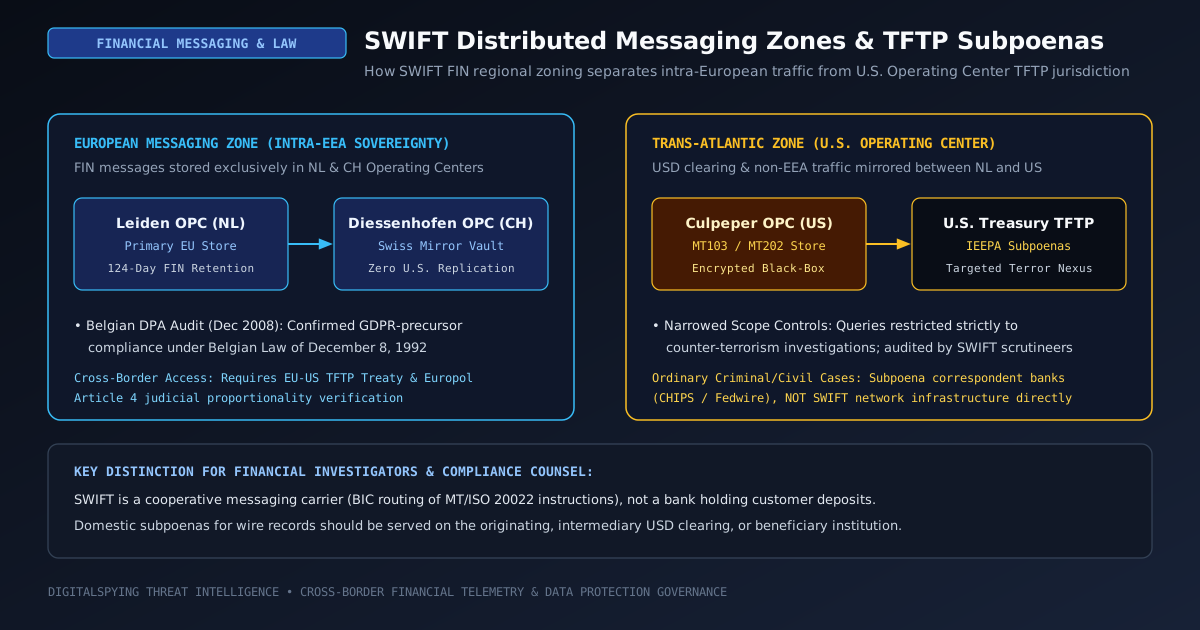
Prior to 2009, SWIFT mirrored all global FIN payment messages symmetrically across two primary Operating Centers—one in Leiden, the Netherlands, and one in Culpeper, Virginia, in the United States—holding encrypted message copies in temporary recovery storage for 124 days. Following the September 11, 2001 attacks, the U.S. Department of the Treasury's Office of Foreign Assets Control (OFAC) served compulsory administrative subpoenas on SWIFT's U.S. Operating Center under the International Emergency Economic Powers Act (IEEPA, 50 U.S.C. § 1702) and the United Nations Participation Act, establishing the classified Terrorist Finance Tracking Program (TFTP).
After public disclosure of the program sparked European data-protection inquiries, SWIFT collaborated with European and international data-protection working groups to overhaul both its contractual transparency disclosures and its physical server topology. In December 2008, the Belgian Privacy Commission (Commission for the Protection of Privacy) formally concluded that SWIFT's enhanced governance, scrutiny controls, and architectural roadmap complied with applicable Belgian data-protection law—culminating in the launch of SWIFT's Distributed Architecture:
| Messaging Zone | Operating Center Pair | Geographic Routing Scope | Subpoena & Treaty Jurisdiction |
|---|---|---|---|
| European Messaging Zone | Leiden (Netherlands) + Diessenhofen (Switzerland — operational 2009/2010) | Intra-European Economic Area (EEA), Swiss, and participating regional financial institutions | Messages never transit or mirror to U.S. servers; U.S. TFTP requests require formal diplomatic routing under the 2010 EU-US TFTP Agreement verified by Europol (Article 4) |
| Trans-Atlantic Messaging Zone | Leiden (Netherlands) + Culpeper, Virginia (U.S. Operating Center) | U.S., Americas, Asia-Pacific, and cross-zone USD correspondent messages | Data physically resident at the U.S. Operating Center remains subject to valid, enforceable U.S. Treasury TFTP subpoenas under strict counter-terrorism audit controls |
Safeguards Inside the Terrorist Finance Tracking Program (TFTP)
Even within the Trans-Atlantic Zone, SWIFT does not provide law enforcement with unfettered bulk browsing access to global banking traffic. Under SWIFT's subpoena compliance architecture and the binding EU-US TFTP framework:
- Strict Subject-Matter Limitation: TFTP extraction queries are legally restricted exclusively to specific, articulated counter-terrorism and terrorism-financing nexus investigations—expressly prohibiting queries for ordinary tax evasion, commercial espionage, or routine domestic white-collar litigation.
- Encrypted "Black-Box" Extraction & Independent Scrutineers: Subpoenaed message subsets sit inside a segregated, hardware-encrypted production environment where cleared independent scrutineers (including SWIFT-appointed and EU-appointed overseers) verify in real time that every individual search selector (such as an IBAN, BIC, or named terror financier) matches a documented terrorism investigation before decrypted message fields are returned.
- 124-Day EphemeralFIN Window: Because SWIFT's operational
FINrecovery databases purge raw traffic automatically after 124 days on the live switch, historical multi-year wire reconstructions cannot rely on transient switch buffers alone.
Practical Playbook: How Domestic Investigators Trace International Wires
Because ordinary state, local, and non-terrorism federal criminal subpoenas are not fulfilled through the U.S. Treasury TFTP pipeline—and because Belgian blocking and bank-secrecy statutes govern SWIFT SCRL's corporate seat in La Hulpe—financial crime investigators trace cross-border SWIFT wires far faster and more completely by targeting the correspondent settlement rail:
- Subpoena New York USD Correspondent & CHIPS Clearing Banks: Over 90% of international U.S.-dollar-denominated wire transfers between two foreign banks still clear through U.S. correspondent accounts held at major New York clearing banks. Serving a grand jury or administrative subpoena on CHIPS or the U.S. intermediary bank returns the complete
MT103/pacs.008payload—including Field:50K:(Ordering Customer), Field:52A:(Ordering Institution BIC), Field:57A:(Account With Institution), Field:59:(Beneficiary IBAN/Account), and Field:70:(Remittance Information)—maintained for five years under Bank Secrecy Act (BSA) Travel Rule retention mandates (31 CFR § 1010.410). - Utilize FinCEN 314(a) & Egmont Group FIU Channels: For cross-border money laundering cases, pairing U.S. correspondent bank wire logs with Financial Crimes Enforcement Network (FinCEN) queries and Mutual Legal Assistance Treaty (MLAT) requests to the foreign originating bank recovers the underlying KYC onboarding dossier and online-banking login IP addresses behind the wire instruction.
Key Takeaway for Compliance & Forensics Teams
SWIFT's Distributed Architecture and Belgian/EU data-protection accords establish strict territorial boundaries around intra-European financial messaging while preserving audited counter-terrorism TFTP subpoena compliance at its U.S. Operating Center. For commercial fraud, ransomware tracing, and asset recovery, BSA five-year correspondent bank wire archives remain the primary domestic evidentiary source.