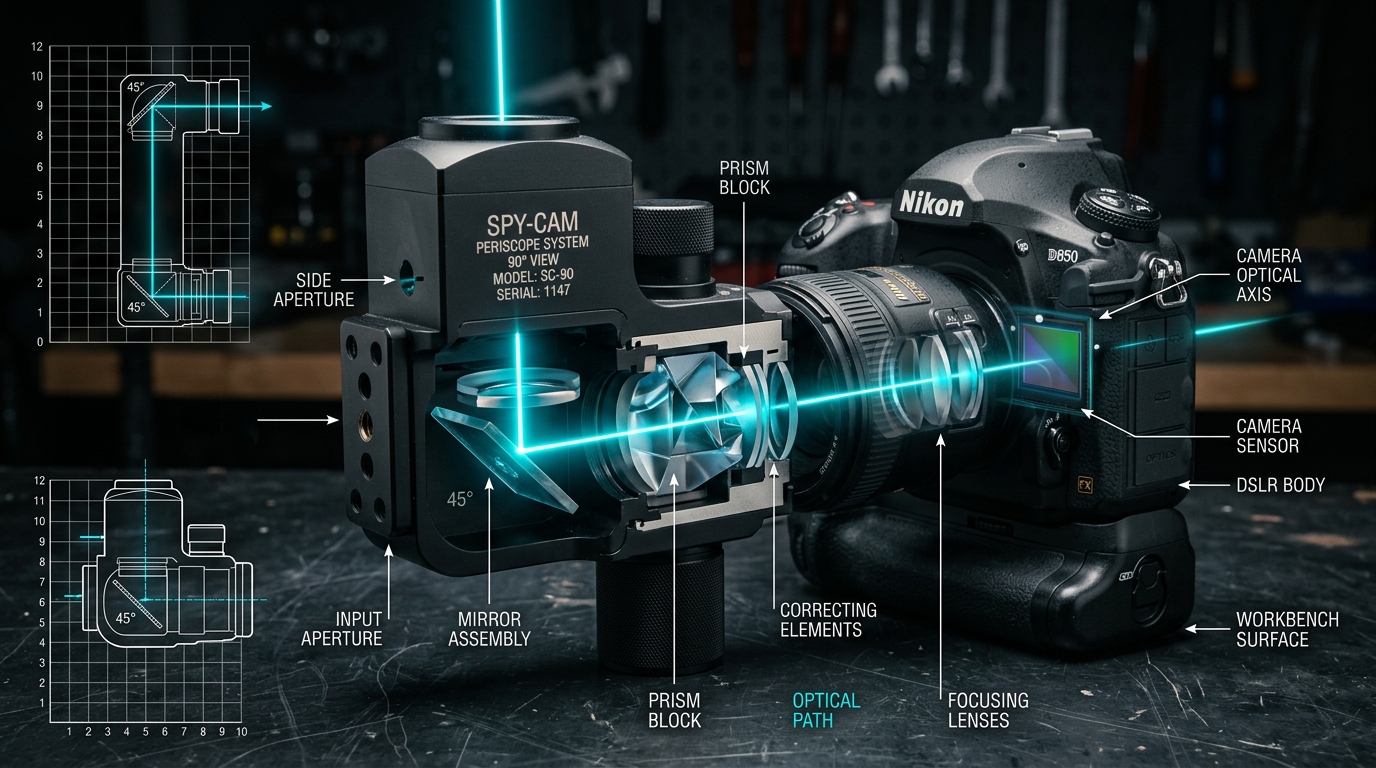
With large front elements and long telephoto barrels, professional DSLR and mirrorless cameras immediately draw attention in public environments, altering subject behavior the instant a lens is raised. Popularized in consumer photography catalogs by Photojojo's Super-Secret Spy Lens (retailing between US$50 and US$85 depending on filter-thread adapter combinations), 90-degree right-angle mirror attachments allow street photographers and physical surveillance operatives to record subjects standing directly to their left, right, or above while pointing the camera body ninety degrees away toward an innocuous decoy backdrop.
Optical Physics of 90-Degree First-Surface Mirror Tubes
Unlike refractive telephoto converters that route incoming light coaxially down the center of the lens barrel, a right-angle spy attachment functions as a single-bounce lateral periscope. An anodized aluminum cylinder threads directly onto the host lens's front filter ring (commonly 52 mm, 58 mm, 67 mm, or 72 mm via step-up and step-down adapter rings). Inside the blackened anti-reflective chamber, an optically flat first-surface (front-surface) mirror is mounted at a precise 45-degree angle relative to the camera's CMOS sensor plane.
Why is a first-surface aluminized or dielectric mirror mandatory rather than an ordinary household second-surface mirror? In standard bathroom or automotive mirrors, the reflective metallic layer sits behind a sheet of float glass; light reflects off both the front air-glass boundary (~4% Fresnel reflection) and the rear silvered surface, producing unmistakable double-image "ghost" contours at high focal lengths. Coating the optical mirror on its exposed front face eliminates refractive glass traversal entirely, preserving crisp edge acuity on high-resolution sensors.
To complete the visual deception on the street, high-end right-angle barrels incorporate a non-functional dummy glass element flush with the front end of the cylinder. Passersby standing directly in front of the camera operator see what looks like a conventional telephoto zoom hood aimed straight ahead, while incoming rays from the true target enter through a lateral rectangular window cut into the side of the 360-degree rotating collar.
| Optical Parameter | Engineering Specification | Operational & Forensic Impact |
|---|---|---|
| Optical Deflection Angle | 90° perpendicular to host lens axis across a 360° rotating friction collar | Permits waist-level, bench-resting, or decoy-facing collection across horizontal and vertical axes |
| Reflective Element Type | Front-surface vacuum-deposited aluminum or multi-layer dielectric mirror | Zero secondary glass ghosting or chromatic dispersion; vulnerable to fingerprint abrasion if touched |
| Usable Focal-Length Window | Optimized for 50 mm to 135 mm full-frame equivalent focal lengths (35 mm+ on APS-C) | Focal lengths wider than 35 mm image the interior walls of the side cutout, creating hard mechanical vignetting |
| Single-Bounce Parity Inversion | Horizontal (chirality) left-to-right mirror flip across raw sensor capture | Street signs, wristwatches, and license plates record backward unless flipped horizontally in post-processing |
| Effective Light Loss | Approximately 0.25 to 0.50 EV (f-stops) depending on mirror reflectance (88%–96%) | Negligible penalty in daylight; forces slightly higher ISO or slower shutter speeds at dusk |
Image Forensics: Detecting Right-Angle Mirror Captures
In evidentiary photo authentication and counter-intelligence media analysis, single-mirror right-angle attachments leave telltale geometric and radiometric signatures when an operator forgets—or imperfectly applies—post-capture corrections:
- Unflipped Chirality Clues: If raw files (
CR2/NEF/ARW) or unedited JPEGs are seized directly from an SD card before post-processing, every single-mirror frame exhibits horizontal parity inversion—rendering vehicle license plates, garment logos, and background storefront lettering in reverse mirror script while preserving authentic camera EXIF serial headers. - Asymmetric Illumination Falloff: When mounted on mid-range zooms (35 mm–50 mm) at wide apertures (
f/1.8–f/2.8), the lateral aperture window clips oblique marginal rays asymmetrically, producing slight shading falloff along one edge of the frame rather than radially symmetric lens vignetting.
Protective Detail & Counter-Surveillance Recognition
Executive protection teams, courthouse marshals, and facility security officers conducting perimeter counter-surveillance sweeps should train personnel to look past where a camera body is pointed and inspect the front barrel geometry:
- Solid Cylindrical Hood With Lateral Cutout: Genuine tulip/petal lens hoods flare outward at the front rim to block stray flare while keeping the front glass unobstructed. A matte-black cylinder capped with flat decoy glass and featuring a side-wall aperture cutout is an unmistakable right-angle periscope attachment.
- Prolonged Perpendicular Standoff: An individual repeatedly framing static architectural features, parked cars, or blank walls while positioned at an exact 90-degree angle to a sensitive embassy gate, secure loading dock, or hotel entrance warrants immediate observation.
- Retro-Reflective Optical Augmentation: Remember that electro-optical laser lens finders ("cat's-eye" retro-reflection detectors) still bounce off the host camera's CMOS sensor filter stack along the 90-degree reflected axis—meaning an active optical sweep conducted from the protected doorway will catch the glint inside the side cutout even though the camera body faces down the street.
Adapter Ring & Field Setup Note
Photographers testing right-angle attachments for candid documentary work should verify the host lens's front filter diameter (stamped next to the ⌀ symbol on the lens barrel), stop down between f/4 and f/5.6, and zoom past 50 mm full-frame equivalent to achieve clean edge-to-edge coverage.