A grim paradox currently defines the JavaScript security landscape: the industry's dominant package registry (npm) continues to suffer devastating, self-propagating supply chain compromises, while the primary alternative runtime engineered specifically to eliminate those architectural flaws (Deno) is winding down independent commercial operations following its acquisition by Cloudflare. As highlighted in recent developer security commentary (Awesome's breakdown of the npm and Deno shakeup), this convergence exposes an uncomfortable reality for security architects. The safest runtime sandbox lost the commercial adoption war, leaving engineering teams with no choice but to harden Node.js and npm against increasingly automated adversary campaigns.
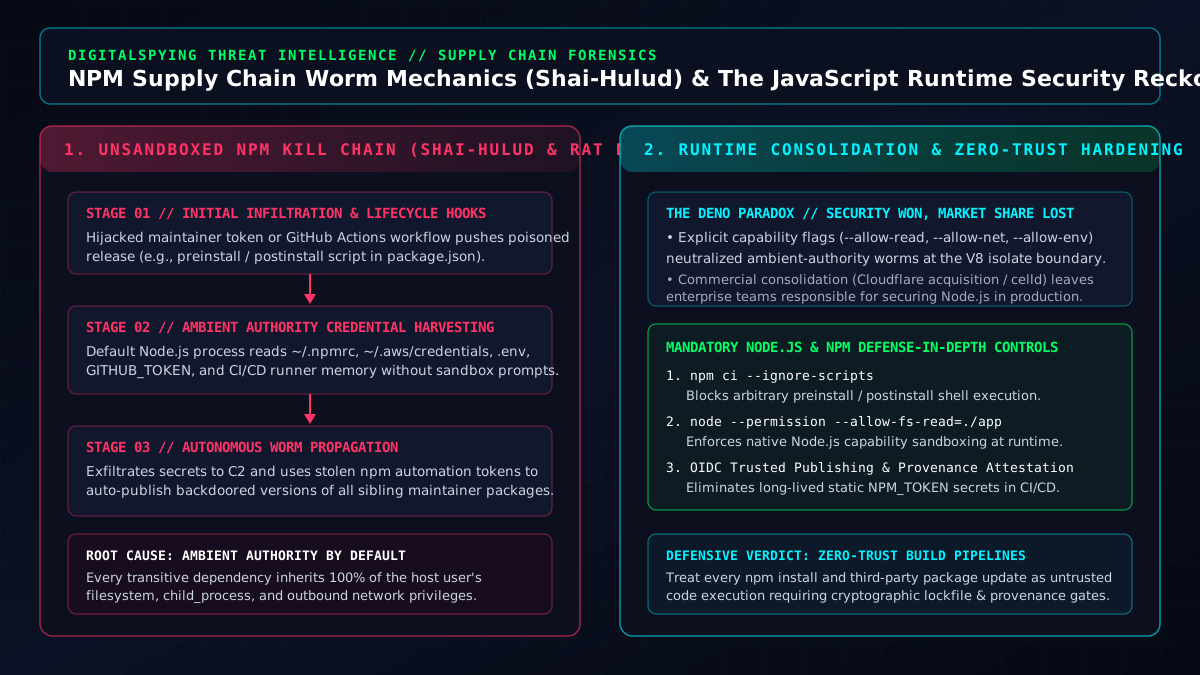
- Active Attack Vector: Self-replicating npm malware (such as the Shai-Hulud worm) and targeted maintainer account takeovers (including the
axiosRAT dropper incident) abusepackage.jsonlifecycle hooks and ambient host privileges. - Law Enforcement Action: Joint operations by the Australian Federal Police (AFP) and the FBI resulted in arrests of suspected TeamPCP syndicate members tied to large-scale credential harvesting via Shai-Hulud, yet copycat worm variants remain active in the wild.
- Runtime Consolidation: Cloudflare's acquisition of Deno (primarily for its Rust-based
celldself-hosted Worker/Durable Objects engine) and the scheduled sunset of Deno Deploy cement Node.js as the permanent enterprise default—making native Node.js sandboxing mandatory.
1. Why NPM Keeps Getting Compromised: The Ambient Authority Flaw
To understand why the npm ecosystem repeatedly falls victim to wormable malware and remote access trojans (RATs), security teams must look past individual phishing incidents and examine the underlying execution model of Node.js and the npm CLI. By default, Node.js operates under ambient authority: every imported module—and every transitive sub-dependency nested six layers deep inside node_modules—executes with the exact same operating system privileges as the developer or CI/CD runner invoking the process.
When a developer executes a standard npm install, two high-risk operations occur automatically unless explicitly blocked:
- Unrestricted Lifecycle Hook Execution: The npm CLI parses
scripts.preinstall,scripts.install, andscripts.postinstallinside every downloaded package'spackage.jsonand spawns an unsandboxed system shell (/bin/shon Linux/macOS orcmd.exeon Windows). - Full Filesystem and Environment Visibility: Code executed during installation or runtime can read
~/.npmrc,~/.ssh/id_ed25519,~/.aws/credentials, local.envfiles, and in-memory CI/CD secrets (GITHUB_TOKEN,NPM_TOKEN) while opening arbitrary outbound TLS sockets to command-and-control (C2) servers.
In a dependency graph where a typical modern web application pulls in 800 to 1,500 transitive packages maintained by hundreds of independent volunteers, a single compromised maintainer credential turns trusted build pipelines into automated credential harvesters.
2. Inside the Shai-Hulud Worm & High-Profile Maintainer Hijacks
The danger of unguarded lifecycle scripts reached an inflection point with the emergence of Shai-Hulud, a self-replicating worm tailored specifically for the npm and GitHub supply chain, alongside targeted compromises of foundational libraries such as axios.
2.1 How the Shai-Hulud Worm Self-Propagates
Unlike traditional typosquatting packages that wait passively for a developer to misspell a library name, Shai-Hulud was engineered as an autonomous worm capable of exponential lateral movement across legitimate packages:
- Stage 1 — Initial Infection via Lifecycle Hook: Once injected into a legitimate package via a compromised maintainer token or an insecure GitHub Actions workflow (such as
pull_request_targetmisconfigurations), the worm triggers via apreinstallscript the moment any downstream developer or build server installs the package. - Stage 2 — Automated Secret Sweeping: The payload scans the host environment for active authentication tokens, specifically targeting
~/.npmrcautomation tokens, GitHub Personal Access Tokens (PATs), and cloud provider environment variables. - Stage 3 — Autonomous Re-Publishing: Rather than merely exfiltrating stolen npm tokens to an external server and waiting for human operators, Shai-Hulud queries the npm registry API to enumerate every other package owned or maintained by the victim. It then programmatically downloads each sibling package's tarball, injects its own malicious
preinstallloader, increments the patch version, and publishes the backdoored release back to npm.
// Simplified forensic representation of worm propagation logic
// 1. Harvest local registry token from developer or CI runner
const npmrc = fs.readFileSync(path.join(os.homedir(), '.npmrc'), 'utf8');
const tokenMatch = npmrc.match(/\/\/registry\.npmjs\.org\/:_authToken=(.+)/);

// 2. Enumerate maintainer packages & inject preinstall hook into sibling tarballs
// 3. Exfiltrate GITHUB_TOKEN, AWS_SECRET_ACCESS_KEY, and .env secrets
2.2 The TeamPCP Arrests vs. Copycat Persistence
Joint cybercrime investigations led by the Australian Federal Police (AFP) and the FBI culminated in the arrest of two suspected operators behind TeamPCP, the threat syndicate accused of orchestrating the Shai-Hulud waves and harvesting hundreds of thousands of developer credentials. While the law enforcement takedown disrupted the original command infrastructure, the technical blueprint of Shai-Hulud is now public knowledge. Copycat threat actors continue to deploy identical self-propagating scripts, and separate supply chain compromises—such as hijacked maintainer accounts pushing trojanized updates like axios@1.14.1 and axios@0.30.4 containing hidden RAT droppers—demonstrate that arresting individual actors does not patch the structural vulnerability of the registry.
3. Why "Deno Gets a Funeral": When Superior Security Loses to Ecosystem Gravity
The tragedy of recurring npm breaches is that Ryan Dahl—the original creator of Node.js—publicly diagnosed these exact security flaws over a decade ago. When Dahl introduced Deno, its foundational value proposition was a secure-by-default V8 isolate sandbox.
In Deno, untrusted code cannot read files, spawn subprocesses, inspect environment variables, or open network connections unless the operator explicitly grants capability flags at invocation:
| Security Capability | Default Node.js / npm Behavior | Deno Sandbox Behavior | Hardened Node.js (v20–v24+) Equivalent |
|---|---|---|---|
| Filesystem Read/Write | Unrestricted access to all user files (~/.ssh, ~/.npmrc) |
Blocked unless --allow-read / --allow-write specified |
node --permission --allow-fs-read=/app |
| Outbound Network I/O | Unrestricted C2 exfiltration over HTTP/DNS/TCP | Blocked unless --allow-net=api.example.com specified |
Requires OS-level eBPF / egress firewall or container network policy |
| Child Process Spawning | Unrestricted shell execution via child_process.exec |
Blocked unless --allow-run specified |
Blocked under --permission unless --allow-child-process set |
| Install-Time Scripts | preinstall / postinstall run automatically |
No automatic lifecycle script execution by default | npm ci --ignore-scripts or ignore-scripts=true |
Despite Deno's superior security architecture, integrated TypeScript toolchain, and clean standard library, it collided with an immovable force: the network effect of two million existing npm packages. To win enterprise adoption, Deno eventually had to re-introduce broad npm compatibility and package.json support—partially reopening the very supply chain surface it sought to leave behind. Meanwhile, Node.js rapidly narrowed the developer-experience gap by adding native TypeScript stripping, built-in test runners, native fetch, and an experimental permission model.
The result was commercial consolidation. Cloudflare acquired the Deno team primarily for celld—a Rust-based runtime engine that packages Cloudflare Workers and Durable Objects for self-hosted enterprise infrastructure—while announcing the wind-down of Deno Deploy and a 12-month maintenance horizon for core Deno runtime development. In short, the market voted for backward compatibility over a clean-slate security sandbox.
4. Defensive Engineering Playbook: Hardening Node.js & NPM in Production
Because Node.js and npm remain the undisputed backbone of enterprise JavaScript, blue teams and DevSecOps engineers cannot wait for a new runtime to save them. Defending against Shai-Hulud-class worms and maintainer account takeovers requires enforcing five non-negotiable controls across every developer workstation and CI/CD pipeline.
4.1 Globally Disable Automatic Lifecycle Scripts
The single highest-leverage defense against npm install-time malware is neutralizing automatic preinstall and postinstall execution. Configure both local .npmrc files and CI/CD build steps to block lifecycle scripts by default, explicitly allowlisting only verified native addons (such as esbuild or sharp):
# Enforce in project .npmrc and developer ~/.npmrc
ignore-scripts=true

# In CI/CD pipelines, always use deterministic lockfile installs with scripts disabled:
npm ci --ignore-scripts
4.2 Enforce the Native Node.js Permission Model
Modern Node.js releases (Node 20 through Node 24+) include a built-in, flag-activated Permission Model inspired directly by Deno. When running build tools, microservices, or untrusted scripts, enable --permission to strip ambient filesystem, worker, and child-process privileges:
# Restrict Node.js process to read only the application directory
# Blocks access to ~/.npmrc, ~/.ssh, and child_process spawning
node --permission \
  --allow-fs-read="/opt/app/*" \
  --allow-fs-write="/opt/app/tmp/*" \
  ./dist/server.js
4.3 Eliminate Long-Lived NPM Tokens with OIDC Trusted Publishing
The Shai-Hulud worm relies on stealing static, long-lived NPM_TOKEN secrets stored in developer ~/.npmrc files or GitHub repository secrets. Organizations publishing internal or public packages should revoke legacy automation tokens and migrate to OpenID Connect (OIDC) Trusted Publishing with cryptographic provenance attestations:
- Zero Persistent Secrets: GitHub Actions requests a short-lived, job-scoped OIDC token directly from the npm registry only during a verified release workflow.
- Cryptographic Provenance (
npm publish --provenance): Binds the published package tarball to the exact commit SHA, repository URI, and build runner ledger in Sigstore's transparency log, preventing attackers who hijack a maintainer's password from silently uploading locally built RAT droppers.
4.4 Enforce Lockfile Integrity & Version Cooldown Windows
Most supply chain compromises—including the March 2026 axios poisonings—are detected and unpublished within hours of release. Engineering teams that blindly resolve floating semver ranges (^1.14.0) during container builds are the primary victims.
- Pin Exact Versions: Commit
package-lock.jsonorpnpm-lock.yamland forbid unpinnednpm installcommands in CI. - Quarantine New Releases: Configure dependency update bots (Renovate / Dependabot) or internal artifact proxies (Artifactory / Verdaccio) with a mandatory 72-hour minimum release age cooldown before adopting newly published patch versions.
- Verify Registry Signatures: Run
npm audit signaturesin CI pipelines to cryptographically verify that every package in the lockfile carries a valid registry signature before building production artifacts.