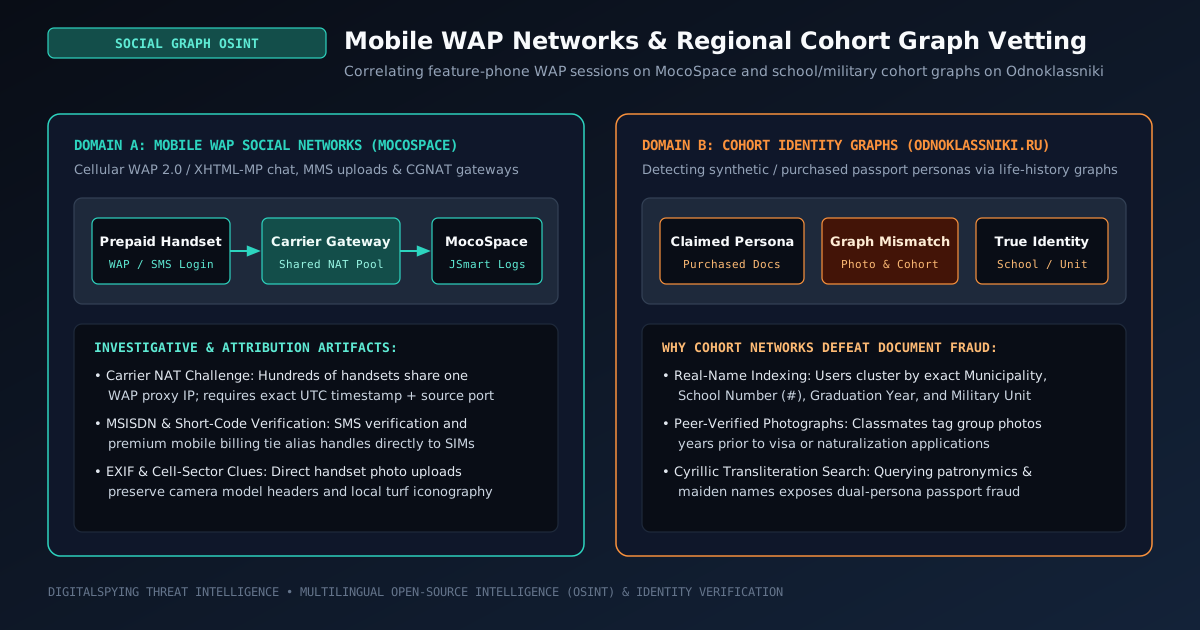
Open-Source Intelligence (OSINT) analysts who restrict social-media reconnaissance to mainstream English-language desktop platforms routinely miss critical communications and biographical contradictions hiding in plain sight. Historical law-enforcement intelligence advisories spotlighting MocoSpace (mocospace.com) and Russia's Odnoklassniki (odnoklassniki.ru / ok.ru) demonstrate how mobile-first Wireless Application Protocol (WAP) chat ecosystems and regional life-cohort networks expose criminal coordination and cross-border document fraud.
Case Vector 1: MocoSpace & Mobile-First WAP Social Networking
While early social-networking investigations focused heavily on desktop-centric portals such as MySpace, Bebo, and Xanga, MocoSpace (operated by Boston-based JSmart Technologies) gained rapid adoption across urban metropolitan areas precisely because it was engineered from the ground up for low-bandwidth cellular browsers (WAP 2.0 / XHTML Mobile Profile) on inexpensive prepaid feature phones and early smartphones.
Through lightweight mobile web sessions and SMS gateways, users could register handles in seconds without owning a home broadband connection—exchanging instant messages, joining regional chat rooms, and uploading direct-from-handset camera photographs and video clips. Gang intelligence units in major U.S. cities identified MocoSpace as a primary venue for turf signaling, witness intimidation, contraband display, and fugitive coordination.
Overcoming Carrier-Grade NAT (CGNAT) Attribution Hurdles
Attributing a mobile-first social profile to a physical handset requires stricter network-timestamp precision than tracing a residential cable modem:
| Technical Layer | Mobile WAP / Cellular Behavior | Forensic & Subpoena Resolution Strategy |
|---|---|---|
| Wireless Gateway IP Sharing (CGNAT) | Hundreds of concurrent cellular subscribers in a region exit onto the public internet through a single shared wireless carrier NAT gateway IP address | Request exact UTC timestamps to the second plus TCP source port numbers from the platform when available, alongside HTTP X-Forwarded-For or carrier WAP proxy headers |
| SMS & Micro-Billing Anchors | Mobile social platforms frequently bind accounts via SMS short-code verification or premium carrier-billed virtual currency ("Moco Gold") | Subpoena platform subscriber records (18 U.S.C. § 2703(c)(2)) for verified 10-digit MSISDNs, SMS verification logs, and mobile billing transaction IDs—bypassing IP NAT ambiguity entirely |
| Handset User-Agent & EXIF Fingerprints | Mobile browsers transmit exact handset make/model strings (e.g., User-Agent / UAProf XML URLs) on every page request | Match platform HTTP User-Agent strings against the physical prepaid burner handset model recovered during arrest or search warrant execution |
Case Vector 2: Odnoklassniki.ru & Cross-Border Passport Identity Vetting
Whereas mobile chat networks thrive on pseudonymous street handles, regional Eastern European and Eurasian cohort platforms—led by Odnoklassniki (literally Russian for "Classmates")—operate on the exact opposite social incentive: real-name biographical discoverability across decades-old peer groups.
As documented in federal immigration vetting advisories, transnational fraud subjects attempting to enter the United States or naturalize under a purchased or stolen identity frequently overlook pre-existing social footprints recorded in their native language. In one reported naturalization investigation, an applicant entered the United States using a purchased passport and biographical identity belonging to another individual, maintained that assumed persona for years, and appeared for a U.S. Citizenship and Immigration Services (USCIS) naturalization interview—only to be confronted with their authentic odnoklassniki.ru profile photographs and biographical history proving they were not the person named on their travel documents.
Why Life-Cohort Graphs Defeat Synthetic & Purchased Identities
Unlike interest-based social feeds where a fraudster can easily fabricate a fresh alias, Odnoklassniki organizes its social graph around immutable institutional cohorts:
- Granular Institutional Indexing: Profiles are indexed by specific Oblast/City, numbered secondary school (e.g., School № 42), exact graduation year, university faculty, and compulsory military service unit numbers (Voinskaya Chast / в/ч) along with years of deployment.
- Third-Party Peer Tagging Prior to Fraud: Even if a subject deletes their own account before applying for a visa, former classmates and military unit peers routinely retain uploaded group graduation or barracks photographs from 10 to 20 years earlier with real names, patronymics, and maiden names captioned underneath.
- Cyrillic & Patronymic Search Discipline: Effective background vetting requires querying Cyrillic script spellings, patronymic middle names, diminutive first-name forms (e.g., Aleksandr ↔ Sasha, Yelena ↔ Lena), and reverse facial-landmark comparisons across archived regional school albums.
OSINT Methodology Takeaway
Comprehensive digital background investigations must map the target's actual device habits and linguistic geography—combining prepaid mobile WAP platform checks for domestic street crimes with native-script regional cohort networks (ok.ru, vk.com, regional alumni registries) during cross-border identity verification.