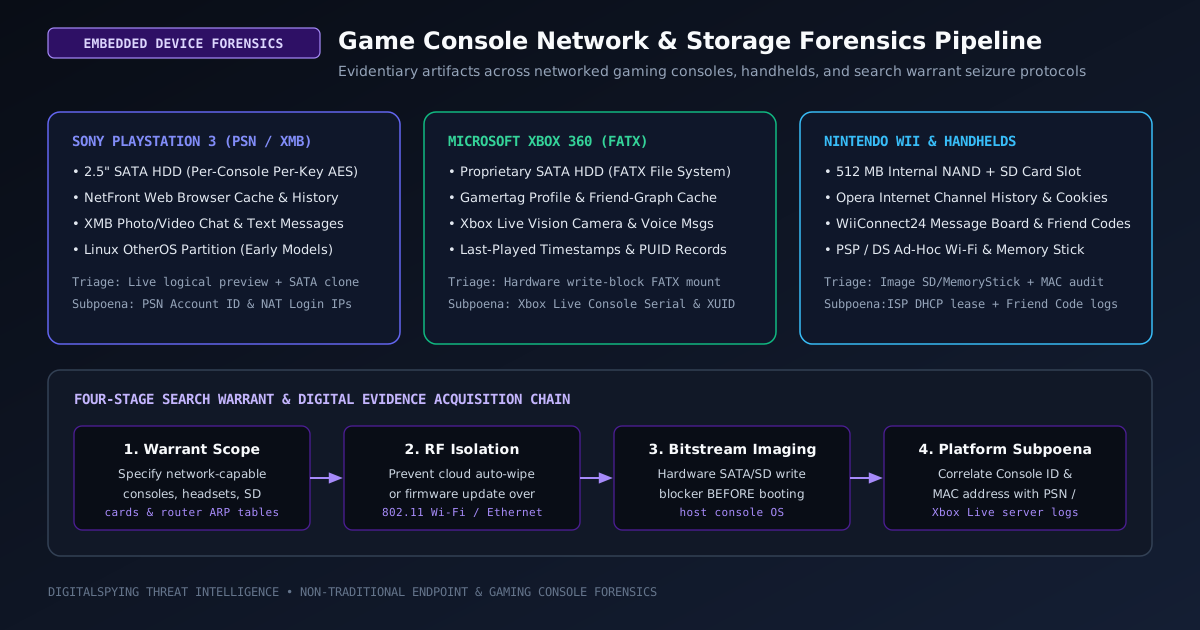
As early as March 2009, an Alachua County Sheriff's Office Criminal Intelligence Unit advisory warned technology-crime investigators of a pervasive operational blind spot: search warrants and probation restrictions drafted narrowly around desktop "computers" routinely left networked seventh-generation video game consoles sitting untouched beneath living-room televisions—even as offenders migrated covert messaging, image exchange, and voice coordination onto console networks.
Why Networked Consoles Function as General-Purpose Computers
Modern home consoles and portable gaming systems—spanning the Sony PlayStation 3 (PS3), Microsoft Xbox 360, Nintendo Wii, Sony PlayStation Portable (PSP), and Nintendo DS/DSi—combine multi-core RISC processors, 802.11 Wi-Fi and Ethernet interfaces, mass-storage file systems, full HTML/JavaScript web browsers, USB peripheral stacks, and peer-to-peer VoIP/video chat subsystems.
Threat actors, including online child-exploitation predators, narcotics traffickers, and financial fraud crews, recognized two structural advantages in moving communications away from Windows or macOS desktops onto gaming platforms:
- Physical Search & Supervision Omissions: First-responder scene teams executing warrants for "desktop and laptop computers" frequently overlooked gaming consoles, USB headsets, webcam peripherals (such as PlayStation Eye and Xbox Live Vision), and SD/Memory Stick media cards. Likewise, legacy supervised-release and sex-offender probation orders barring "personal computers" failed to enumerate internet-enabled gaming hardware.
- Proprietary File Systems & Encrypted Volumes: Standard desktop forensic suites trained on NTFS, FAT32, and HFS+ initially lacked native parsers for Xbox 360
FATXpartitions, console-keyed PlayStation UFS2/encrypted sectors, and raw Wii NAND dumps.
Platform-Specific File Systems & Recoverable Artifacts
Every major console generation leaves distinct, high-value evidentiary traces both locally on non-volatile storage and remotely on platform authentication servers when properly preserved:
| Gaming Platform | Storage Medium & File System | High-Value Local Artifacts | Platform Subpoena & Network Identifiers |
|---|---|---|---|
| Sony PlayStation 3 | 2.5-inch removable SATA HDD encrypted with per-console hardware EidRootKey; USB/CF/SD/MemoryStick slots on early SKUs | XrossMediaBar (XMB) text/photo messages, NetFront web browser history/bookmarks/cache, PlayStation Eye video chat logs, early-firmware OtherOS Linux ext3 partitions | PlayStation Network (PSN) Account ID, Console IDPS serial, MAC address, NAT public IP login history, PlayStation Store billing records |
| Microsoft Xbox 360 | Proprietary caddied SATA HDD or internal Slim flash formatted with Microsoft FATX (Partition 3 user data) | Gamertag profile packages (CON/LIVE containers), Xbox Live friend-request graphs, cached voice/text message headers, LastPlayed UTC timestamps, PUID metadata | Xbox Live XUID, 12-digit Console Serial Number, Console Certificate ID, historical Xbox Live session IP addresses & payment cards |
| Nintendo Wii | 512 MB internal NAND flash (encrypted hierarchical FS) + removable front-bay SD/SDHC card | Opera-based Internet Channel URL history and cookies, WiiConnect24 Message Board logs, 16-digit Wii Console Friend Codes, photo channel JPEG views | Nintendo Wi-Fi Connection MAC-to-IP session bindings, home router DHCP lease tables, ISP timestamp correlation |
| Sony PSP & Nintendo DS/DSi | Memory Stick PRO Duo (FAT16/FAT32) and DSi internal NAND + SD card | Built-in NetFront/Opera browser caches, ad-hoc 802.11 Wi-Fi SSID connection histories (up to 3–10 saved access points with WEP/WPA keys), unallocated JPEG/MP4 carving | Saved wireless router BSSIDs (correlatable via WiGLE/field surveys to prove physical presence near victim or stash locations) |
Scene Seizure, RF Isolation & Laboratory Triage Protocol
Improperly powering on a seized gaming console in a connected forensic lab can destroy volatile evidence immediately. If an Xbox 360 or PlayStation 3 associates with an open Ethernet port or saved Wi-Fi access point during examination, automatic background synchronization can overwrite cached message queues, apply mandatory firmware updates, or execute remote profile sign-outs.
Four Mandatory Best Practices for Examiners
- Draft Device-Neutral Functional Warrant Language: Search warrant affidavits and probation conditions should define covered endpoints functionally—encompassing "any electronic device capable of storing digital files or transmitting voice, text, image, or video data over a local or wide-area network, expressly including video game consoles, handheld gaming devices, console hard drives, memory cards, optical media, cameras, and voice headsets."
- Isolate Network Interfaces Prior to Inspection: Photograph rear cable connections on scene, record the home router's ARP/DHCP client table to bind console MAC addresses to local LAN IPs, and boot consoles strictly inside an RF-shielded room or disconnected workbench when live triage is required.
- Image Storage Media via Hardware Write-Blocker First: For Xbox 360 drives, remove the SATA drive from its enclosure and acquire a full sector-by-sector E01/raw bitstream image through a hardware SATA write-blocker before mounting
FATXpartitions in X-Ways, Autopsy, or specialized Gamertag container parsers. For PS3 units—where removing the SATA drive and inserting it into any other PS3 triggers an automatic destructive reformat prompt—always clone the raw SATA drive sector-for-sector onto a blank sacrificial drive first if live XMB preview on the original console hardware becomes necessary. - Preserve Peripheral Accessories: Seize USB keyboards, chatpads, headsets, and camera attachments alongside the host unit; physical possession of a QWERTY controller chatpad or webcam directly corroborates active messaging and video transmission intent.
Probation & Supervision Modernization
Parole officers, pretrial services units, and digital forensic laboratories should audit standard computer-monitoring addenda annually to ensure networked consoles, VR headsets, smart TVs, and portable gaming handhelds are explicitly governed under device inspection clauses.