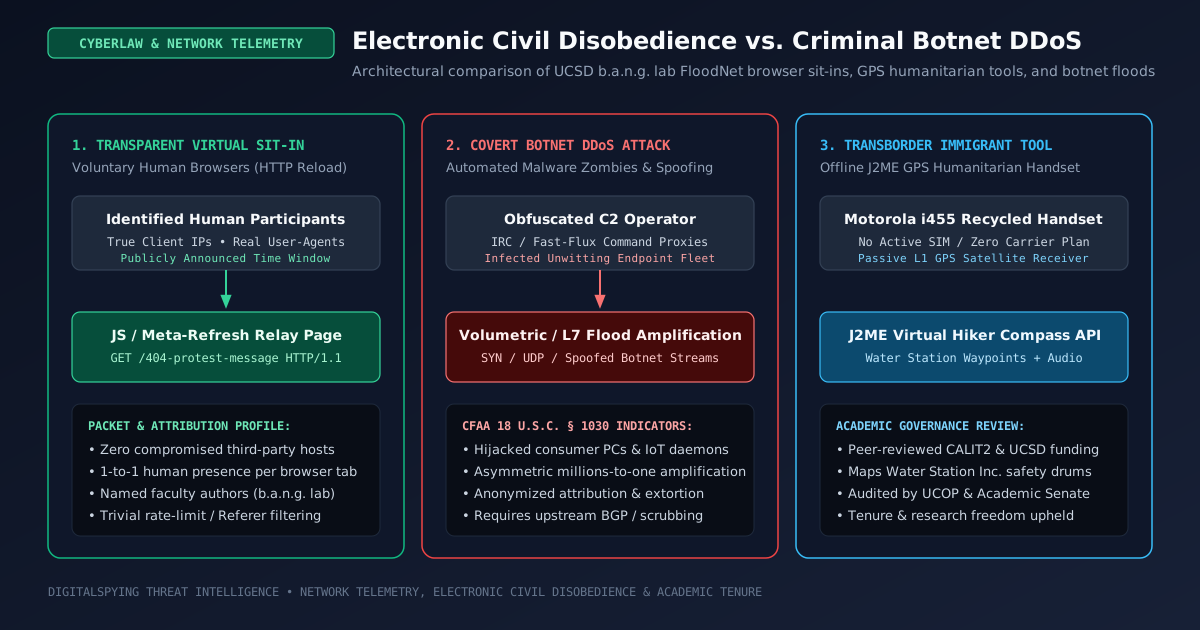
In April 2010, University of California, San Diego (UCSD) Visual Arts Associate Professor Ricardo Dominguez—co-founder of the Electronic Disturbance Theater (EDT) and principal investigator at UCSD's b.a.n.g. lab (bits, atoms, neurons, genes)—became the center of a landmark collision between academic research governance, border-humanitarian embedded hardware, and federal computer-intrusion law after threats of tenure revocation and criminal referral from the UC Office of the President (UCOP).
Two Converging Flashpoints at UC San Diego
The administrative investigation against Dominguez arose from two distinct peer-reviewed tactical media projects developed openly inside the university's California Institute for Telecommunications and Information Technology (CALIT2) ecosystem:
- The Transborder Immigrant Tool (TBIT): An embedded humanitarian navigation application loaded onto ultra-low-cost, recycled GPS-capable flip phones designed to point distressed travelers crossing the California-Mexico desert toward public emergency water drums maintained by nonprofits such as Water Station Inc.
- The March 4, 2010 UCOP Virtual Sit-In: During statewide student and faculty protests against University of California tuition hikes and budget cuts,
b.a.n.g. labdeployed its classic browser-refresh Electronic Civil Disobedience (ECD) script—descended from 1998's Zapatista FloodNet applet—pointed atucop.edu.
Crucially, both lines of inquiry had been transparently disclosed, peer-reviewed, funded through UCSD internal academic grants, and repeatedly signed off on by senior campus administrators during Dominguez's formal academic merit and tenure evaluations—until political pressure from members of Congress and media controversy triggered retroactive legal and disciplinary scrutiny.
Network Telemetry: Virtual Sit-Ins vs. Criminal Botnet DDoS
From a network security and digital forensics perspective, conflating a 1990s-style browser virtual sit-in with a criminal Distributed Denial-of-Service (DDoS) attack obscures fundamental differences in packet generation, endpoint consent, amplification mechanics, and defensive mitigation.
| Technical Dimension | Transparent Virtual Sit-In (FloodNet / ECD) | Criminal Botnet DDoS Flood |
|---|---|---|
| Traffic Origination | Voluntary human participants holding open a visible browser tab executing client-side JavaScript or HTML meta refresh | Tens of thousands of covertly compromised consumer PCs, servers, or IoT daemons controlled via C2 channels without owner consent |
| Amplification Ratio | 1:1 human-to-socket proportionality—bandwidth ceases the instant participants close their browser tabs | 1,000:1 to 50,000:1 asymmetric amplification via DNS/NTP reflection, SYN floods, or headless HTTP/2 rapid-reset daemons |
| Identity & Attribution | Unspoofed client IP addresses, standard browser User-Agents, clear Referer headers, and publicly named organizers | Spoofed source IP headers, anonymized bullet-proof proxies, Tor/fast-flux C2 infrastructure, and concealed criminal operators |
| Server Log Footprint | Symbolic HTTP GET requests (often requesting conceptual URIs such as /human_rights_not_found to log political speech inside access.log) | Exhaustion of kernel TCP backlog queues, TLS handshake CPU saturation, or database-locking cache-bypass queries |
| Defensive Mitigation | Trivially mitigated in seconds via a single Nginx/Apache Referer block or per-IP token-bucket rate limit | Requires upstream BGP blackholing, Anycast scrubbing centers, and ISP-level ACL coordination |
Statutory Tension Under the Computer Fraud and Abuse Act
While network engineers recognize that a browser-reload page carries a single-URL Referer header and relies strictly on uncoerced human browsers, U.S. cyberlaw under 18 U.S.C. § 1030(a)(5)(A) (the Computer Fraud and Abuse Act) focuses on whether an actor knowingly causes the transmission of a program or command that intentionally impairs the availability of a protected computer causing at least $5,000 in aggregated response costs—without carving out an explicit statutory exemption for symbolic protest.
That gap between artistic performance traditions (modeled on physical campus sit-ins that temporarily crowd an administration hallway) and strict-liability statutory text explains why university counsel reacted aggressively to the March 4 ucop.edu protest, even though the traffic spike was brief, unspoofed, and signed with the researchers' real names.
Embedded Architecture of the Transborder Immigrant Tool
Public controversy surrounding the Transborder Immigrant Tool frequently mischaracterized how the hardware functioned in the field. Rather than providing active encrypted tactical communications or cellular voice plans, the prototype engineered by Dominguez, Brett Stalbaum, Micha Cárdenas, Amy Sara Carroll, and Elle Mehrmand repurposed surplus Motorola i455 Nextel iDEN handsets retailing for roughly $30:
- Zero Cellular Carrier Subscription Required: The handsets operated without active SIM provisioning or cellular tower triangulation, relying instead on passive L1 GPS satellite reception accessible through the phone's Java 2 Micro Edition (J2ME) Location API (
JSR-179). - Low-Cognitive-Load Compass Interface: Recognizing that severe dehydration and heatstroke impair a hiker's ability to read complex topographic maps, Brett Stalbaum's Virtual Hiker algorithm rendered an unmistakable high-contrast directional arrow and triggered haptic vibrations as the carrier approached verified water stations or highway safety corridors, paired with spoken-word poetry and survival advisories.
- Audit & Institutional Outcome: Following exhaustive investigations by UCSD audit teams, UCOP legal counsel, and House congressional inquiries throughout 2010, auditors confirmed zero misuse of state research funds and verified that the software remained in academic prototype evaluation in consultation with border humanitarian groups. UC San Diego declined to revoke Dominguez's tenure, preserving a critical precedent for academic freedom in experimental digital media and civic technology research.
Key Lesson for Incident Responders & Institutional Counsel
When triaging anomalous HTTP traffic spikes on university or municipal infrastructure, forensic responders should immediately inspect Referer headers, TLS fingerprints (JA3/JA4), source-IP ASN distribution, and request rates per socket before classifying browser-originated protest traffic alongside malware botnet intrusions.